

ServiceNow
Connect to ServiceNow. Manage incidents, service requests, CMDB, and IT service management workflows
Connect to ServiceNow. Manage incidents, service requests, CMDB, and IT service management workflows

Supports authentication: OAuth 2.0
Set up the agent connector
Section titled “Set up the agent connector”Register your Scalekit environment with the ServiceNow connector so Scalekit handles the authentication flow and token lifecycle for you. The connection name you create will be used to identify and invoke the connection programmatically. You’ll need a ServiceNow instance and OAuth credentials from your instance’s Application Registry.
-
Set up auth redirects
-
In Scalekit dashboard, go to Agent Auth → Create Connection.
-
Find ServiceNow from the list of providers and click Create.
-
Click Use your own credentials and copy the redirect URI. It looks like
https://<SCALEKIT_ENVIRONMENT_URL>/sso/v1/oauth/<CONNECTION_ID>/callback.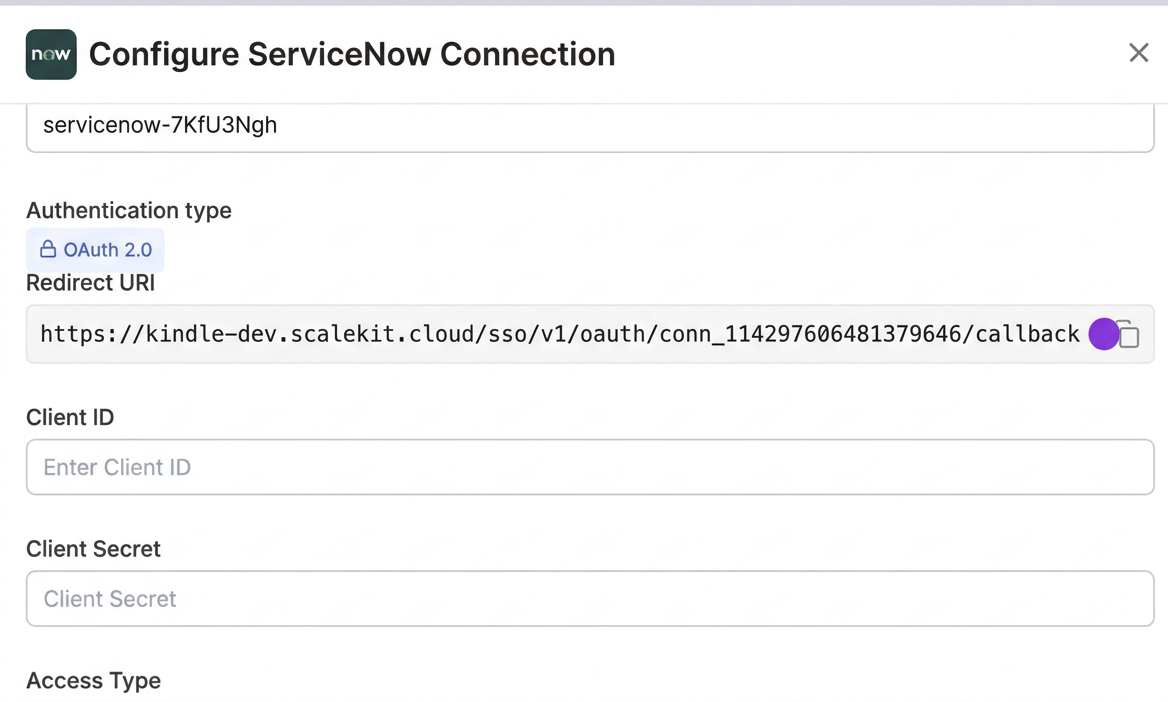
-
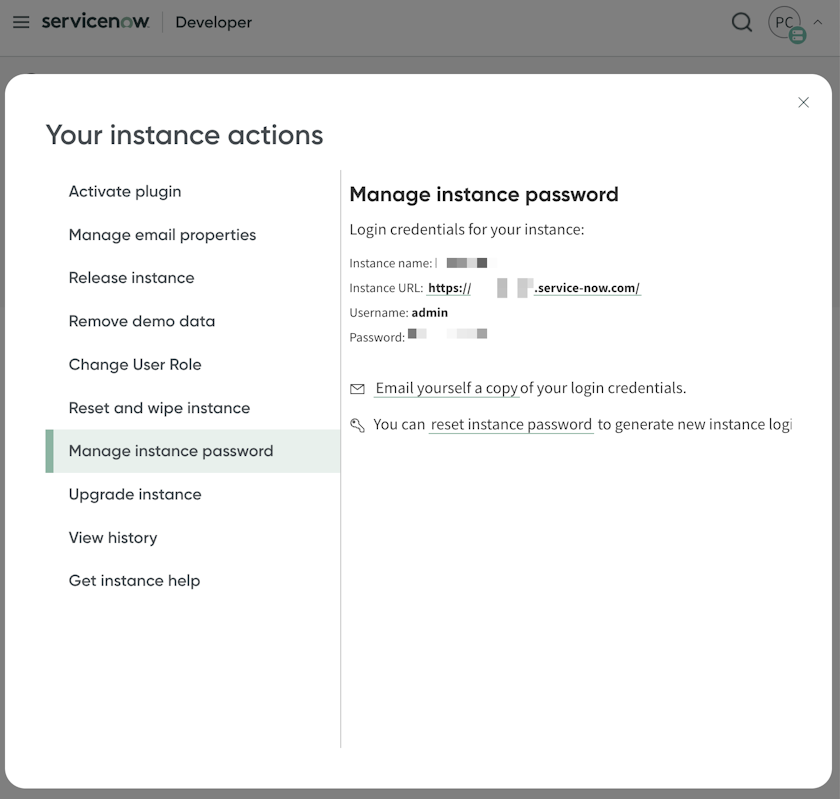
In the ServiceNow Developer Portal, go to your instance and click Manage instance password to find your instance URL.
-
Log into your ServiceNow instance, navigate to System OAuth → Application Registry, and click New → Create an OAuth API endpoint for external clients.
-
Fill in an app name and paste the copied URI into the Redirect URL field, then click Submit.
-
-
Get client credentials
After submitting, open the newly created record in System OAuth → Application Registry:
- Client ID — auto-generated, listed under Client ID
- Client Secret — click the lock icon next to Client Secret to reveal it
-
Add credentials in Scalekit
-
In Scalekit dashboard, go to Agent Auth → Connections and open the connection you created.
-
Enter your credentials:
- Client ID (from your ServiceNow Application Registry)
- Client Secret (from your ServiceNow Application Registry)
-
Click Save.
-